Showing posts with label pumpkin. Show all posts

Thursday, July 17, 2014

First bloom! Pumpkin sonnets

Yesterday evening, the pumpkin plant's first buds looked full and yellow and ready to burst.
July 16, 2014 about 9:00 pm

July 17, 2014 about 9:00 am

I took inspiration for my morning writing from the pumpkin plants and the new flowers. "10 lines of iambic pentameter," I though to myself, "that will be easy." I've written about the pumpkin for so many years now. I figured sitting on a stool with my notebook right beside the plant would allow me to write freely and quickly. After a good forty-five minutes, I went inside to my computer with one scratchy page of writing--too scratchy even to count lines accurately.

I typed and redrafted extensively at my desk, all the while feeling less certain that the effort and time put into the exercise made any sense at all. I'm still not sure. But I have fourteen lines, some of which push boundaries of iambic pentameter past where I can comfortably evaluate them. Multi-syllable words and shifting emphases (anapests, trochees, dactyls and anything else that feels differently weighted) are a challenge. On the other hand, I've wanted to push past relying on one-syllable words connected by articles, conjunctions and prepositions. So, I give you fourteen lines of iambic pentameter, vaguely in the form of a sonnet.
[First bloom] 
Broad green leaves, part maple-shaped, part heart,
cleft and round where hollow stem meets veins
of beige that branch and re-branch to each leaf’s edge,
shade-making, dew-holding, chlorphylled veil,
a membrane lofty, thin and brave, prepares
to be sustenance for fruit that’s yet to come,
to shelter it from heavy rain and sun,
transforming light and air to feed new buds
now bursting through the calming cover of leaves
like jesters’ hats of wrinkled orange-gold.
They beckon flying creatures to come and coat
their bellies and bee-hinds in yellow powder
    then buzz away to roses, phlox or cat-mint—
    too soon to find and bless a pumpkin’s mate.

The first pumpkin nectar for bees in 2014.

July 17, 2014 First potential pumpkin of the season,
with adult human female toenail for scale comparison.

I recalled today that I wrote a sonnet about the pumpkin in 2008 while taking Tim O'Keefe's English 2500 Introduction to Creative Writing at the University of Utah. I was forty-five years old in a mostly undergraduate-aged class. I believe it is fair to say I cut my teeth in Tim's class. The pumpkin sonnet was my back-up, and the class much preferred my much less traditional dishwasher sonnet. (If I hear any requests, I'll post the dishwasher sonnet, too.) From February 2008:
[I grow a pumpkin aching back to you] 
I grow a pumpkin aching back to you,
My dear sweet child, my babe, my first-born son.
A sprouted seed held in a cup it grew—
At first we let it languish without sun.
Yet something urged me plant it in the earth
To carry on what school friends had not doubted
By sticking pumpkin seeds in soot-brown dirt
And watching awestruck as each green shoot sprouted.
Bent-backed, broad-leaved it crawled on thick-vined knee:
Straight toward your sick room restlessly it tore
As if wild growth could ease your agony.
One fruit all golden, full and round it bore
    That you might live beyond your seventh year
    And I, the tender, hold you thus still near.

Sunday, July 13, 2014

Deadheading (flash post)

I think (in the garden)
therefore I blog

Today's project: cutting back the dried up blooms in my flower bed before they go all the way to seed. The practice, known as deadheading, is one I learned from my mother, who found she could assign me to the pansy bed and ask me to pinch off the wilted flower heads with their thin stems. Pansies, she told me, are called "little kitten face" in Chinese. Sometimes I filled tiny vases with pansy bouquets. Generally, I objected less strenuously to this task than to others, such as yanking out the ivy runners infiltrating the lawn to prune them back. "If that's so important to you," I spat in preteen indignation, "then do it yourself!" (The line requires exiting at a run. Apparently, I still feel a little bad about it.) 

My mother's connection to China goes back to her birth in Suzhou, where her parents served as Methodist missionaries until they fled the Japanese invasion in 1939. Her connection to deadheading comes from her father, primarily, who gardened in the yard around my grandparents' Tenafly, New Jersey home. The deep, shady backyard was a late spring paradise of blossoming dogwood, impatiens, azalea, and rhododendron: white, pink, salmon, and red against lush green and delicate tree bark.

My main backyard activity in Tenafly was the trolly swing Gramp hung across the full width of the yard behind the house between two tall trees. With handles and a seat, the trolley hung as a vertical line from a metal wire and ran on two grooved wheels, making a squealing noise as the rider went forward toward the opposite tree at high speed and backwards, slighly more slowly, to the start. At that point we had to hop off and give the next sibling or cousin a turn to climb up the step ladder and hop on. 

The other backyard pleasure was a cloth hammock strung between two trees perfectly distant from one another. Alone, or with a companion, we rocked back and forth. We played ship. We wrapped ourselves completely within the darkness of the fabric and let ourselves be flipped round and round from the outside. Over time, Gramp noticed we had caused the sturdy S-hooks to bend out of shape.

I expect we ate corn on the cob and spat watermelon seeds into the bushes. I bet we played tag and croquet. But what I remember is the trolly, the hammock, and the impressionist painting look of the grove of blooming bushes and trees in early summer.

The point of deadheading, according to Gramp as my mother tells it, is "to frustrate the plant." That is how you keep it blooming, keep it working toward its reproductive mission. Even my snail-nibbled, mildewed yellow coreopsis will bloom longer after I've trimmed these browned stubs back.

Coreopsis, pre-deadheading.
Gramp also advised removing suckers from plants, like the side branches on tomato plants that steal energy from the primary fruit-bearing stems. They look a little like a new arm trying to grow out of an armpit. The biggest pumpkin plant has a few suckers already, but I'm leaving them alone. The plants are tenuous this year. Maybe that would be an argument for eliminating side spurs. At this point, I'm eager to see survival, so I will let them be. Ten years ago, in the inaugural summer of Simon's pumpkin, the ur-pumpkin was already bigger than a softball by mid-July. There's still time before the fall frosts, of course, but I'd say this is the week for these plants to act like the garden is all theirs.

The biggest pumpkin plant, growing one leaf at a time.

Sunday, July 6, 2014

Signs of maturing (flash post)

I've been watching these pumpkins grow for ten years now. My perception grows more specific with time. The first year, 2004, I would notice things after the fact. Oh, the plant has shot a vine along the fence toward the house. Oh, the leaves are all wilted from the heat. Oh, the blossoms are a lovely shade of orange-yellow. Oh, there's a globe shape with watermelon skin resting on the grass.

Now I peer at the plants the way we watch infants for their every change of expression. Here's what I can see today.

"?" remains the frontrunner by a considerable lead.
The long vine has begun to shift from upward growth and will soon rest
on the dirt. The plant means business once it starts sending out
the curling tendrils that will help it grab on.
"?" in close-up. Thin stalks and tight buds show the lanky male flowers
preparing to bloom later. The female flowers have yet to emerge
out at the end of the growing vine. The first two round-edged leaves
from the sprouting seed have begun to dry and drop off the plant.
2011 getting situated.
2012 the runner-up, size-wise, but it still has those first two rounded leaves.
2004 (a) making progress.
2004 (b) growing roots for sure.
Maturation is on my mind. I see that in my poetry fragment about Simon reaching an imagined maturity. I see it when I think of the cousins Simon's age, leaving high school or entering senior year in the fall, as Simon would have been set to do. With amazement I see that I've repeated a pattern in my teaching life. In Salt Lake City, I began teaching middle school (5th-8th graders) a year after Simon died. I thought the children, being much older than Simon, would not remind me painfully of him. The years went by, and soon I was teaching his own age group. I had a group of 7th grade mentees, all born around 1997, like Simon. Now, I teach college students. Most of the students enter straight from high school. In the fall of 2015, the entering class will be young adults the same age that Simon would be.

Saturday, June 28, 2014

Today's look at the pumpkin patch (flash post)

Shaping up the pumpkin patch after restarting the plants. Getting them ready to grow and take over the garden. (Slight reworking of the same post of June 25th.)

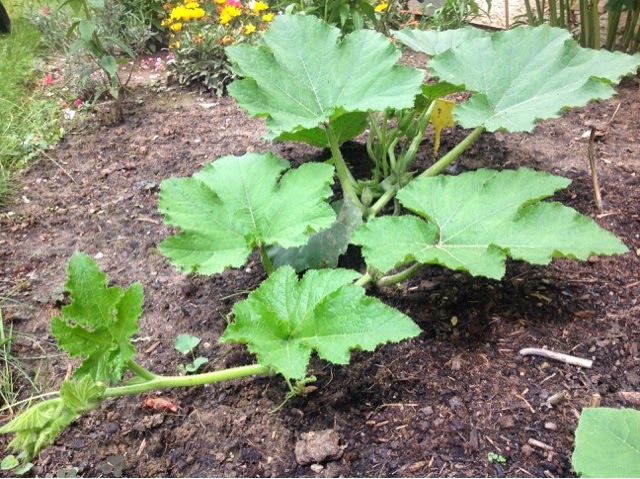
Late June, the pumpkin plants are up and clustered
around five yellow markers.

Too many seedlings competing for nutrients and space.

Alas, I have thinned each spot down to one plant
(although the metaphor of weeding out the weakest causes me some pain--
this is, after all, a pumpkin grown in memory of a sick child).


The current forerunner, a seedling growing solo for several weeks now.
I had planted a random seed before the first plants got munched. Markus
replaced it with one marked 2005 from our neighbor Elizabeth's garden.
So it's not truly a "?" anymore. Those were awesome pumpkins she grew.

I'm looking forward to what happens next (and so is Simon-the-Cat).
All pumpkin posts: http://chapterthis.blogspot.de/search/label/pumpkin

Friday, June 13, 2014

Pumpkin update

"I wonder if they're blooming? You never know what a flower does when you're out."
Simon Craig Vodosek, age 4, April 15, 2002

Simon made that comment as we were driving home from daycare. The weather was unseasonably warm, and I'd asked him what he thought the tulips might be up to, the ones he'd helped plant in the fall. Somehow, the quote came to mind today, and I searched for it in my files. You can read the original Simon Says entry on Simon's Place. Scroll down to find April 15, 2002. But then read the whole page. I found many quotes to chuckle over--just normal times with two kids, aged 2 and 4. And some entries help us understand what it might feel like to be four years old and have cancer.

Seeds from the original 2004 pumpkin, just up since yesterday.
Simon frequently commented about nature in ways both cute and thoughtful. Markus and I always believed we heard an echo of Linda Britt, the wonderful daycare mommy who cared for both Simon and Miriam in Ann Arbor, Michigan. She guided the kids' appreciation of holding roly-poly bugs and hand-picking raspberries. Linda's brilliant rule for little ones: one-finger touching. Kids can't damage a flower by pointing gently at it (just by grasping and mashing or tugging it).

On Simon's birthday, May 17th, I planted pumpkin seeds directly in the soil outdoors, taking advantage of the warm spring. Other years, I've set seeds to sprout in the house on Simon's birthday, then planted them in June. Four days later I was on a three-week trip in the USA, solo. I hired Miriam as my tender and waterer. A week after the planting, she sent a photo of the first sprouted seed. But soon she noticed nibbled off  leaves on all the small plants. Markus helped her replant the pumpkin patch. Knowing they truly always sprout, I had placed a single seed next to each yellow marker. To assure success, Markus said he planted a bunch of seeds at each location and covered them with plastic cones to keep the munchers away.

A cluster of seedlings awaits thinning.
Now Markus knows the pumpkin seeds really do come up. It will be his task to thin these out. I told him if you want to overdo things, then plant two seeds instead of one. 

Growing out of the cone, a pumpkin from year "?"

Soon they'll be big enough to evade the munchers. Pretty soon they'll take over the garden. But for now, they make roots and prepare. Here's what things look like today, June 13th. Miriam made 31.50 Euros, by the way.

About five pumpkin plants this year.
The other end of the garden has the returnees of last summer's perennials. On a sprig of lavender, in front of the gaura (whirling butterfly), there's yet another delight: a real butterfly. The German word, aside from "Schmetterling", for this sort of creature is "Falter", which carries the meaning of folding. I find the word poetic. I'm guessing Simon would, too.

White butterfly alight on lavender.


Sunday, May 18, 2014

Happy 17th Birthday, Simon Craig Vodosek (part 2)

For the tenth time, we've experienced Simon's birthday without Simon. Ten times. His time absent in body has long surpassed the time he was given to live. That's how time and mortality work.

What to do? How do you spend this day? The first several years we sought community and held lemonade stands to raise money for pediatric cancer research in Simon's memory with our friends at Liberty Heights Fresh in Salt Lake City. The very first year we had a full birthday party at the house with Simon's friends, complete with a visit from Marcus the Clown, who had entertained Simon at his Celebration of Life about a month before he died.

Since coming to Germany in 2010, we've been more private and improvisatory. This year, Simon's birthday was a Saturday. We talked about things to do--a walk in a botanical garden, an excursion to the Kletterpark (where you strap yourself on and test your balance on ropes in trees). But we ended up taking it easy at home.

Miriam and I both slept in a bit and woke to find that Markus had made pancakes for breakfast. He had lit the Simon candle:


I lit a second candle. Throughout the long day, we lit candles from the Simon candle as we felt inspired.


Markus had set the breakfast table for four. In front of Simon's place, he put three votive candles. He set the place with an empty coffee mug and an empty water glass. I mentioned the coffee cup, and Markus said he figured Simon would be drinking coffee at 17. I mentioned the empty water glass, when our other three were filled. Yes, Simon doesn't actually need it filled, does he?

I ate my pancakes Simon-style. Markus and Miriam have foresworn butter as an unnecessary source of calories, but I took the chance today to dot butter across Markus' light and fluffy whole wheat pancakes. I enjoyed them in full memory of Simon. I talked about Simon's appreciation of butter on pancakes during Simon's memorial service, and you can read those remarks on simonsplace.org. Look for the section called "Simon the Delighted" for the pancake comment, but I recommend reading the whole tribute to a wonderful child.


Markus surveyed the yard after breakfast and decided to spend time today on the backyard sculpture. He cleaned it and inserted more sand under the base to adjust its slight lean. The sculpture is by Utah artist Chris Coleman, and it preceded the one we commissioned for Simon's Salt Lake City grave (slide show 4).


I spent time in the garden clearing out all the clover and other weeds and preparing the soil for this year's pumpkins. Amid the remaining tulip leaves, you can see five yellow markers. I sometimes start seeds indoors on (or near) Simon's birthday. This year, with the spring so advanced, I've stuck seeds directly in the ground. Two of the seeds come from the original Simon's pumpkin (January 2, 2008 entry). The others came from pumpkins I've grown here other years.


For dinner, we picked sushi, the kind I've made for years to everyone's pleasure, rolling nori and rice around steamed carrot, cucumber, avocado, and "sushi egg". Everyone loves it, every time. Sushi egg reminds us especially of Simon because I used to make it for him around 9:00 pm the nights before he had an NPO appointment at the hospital the next morning. When he wouldn't be allowed to eat breakfast, he had breakfast at bedtime instead. Sushi egg was his usual choice.


Miriam doesn't want to be in my postings, so that's a sliver of her across from Markus. While setting the table for dinner, we noticed several things. The placemat Markus found for Simon's place is less faded than the other three. The fourth pair of chopsticks was in a different drawer from the others. Laying out a place for Simon and putting those items away again was a mindful ritual. I'm glad we did it. Simon left a great big space behind him. It feels right to recognize the space. Perhaps we can even use the space--a place to grow, a place to breathe, a place to renew. (I wouldn't do it every day, but it felt fitting to honor his place among us for his birthday.)


Sam and Simon-the-Cat are still here! The boys will be 11 in August. They came to us half a year before Simon died. They watched over him as he lay dying. Now they offer us--especially Sam, especially Miriam--enduring companionship. 


Markus made this year's strawberry pie.


The candle burned all day. It's still burning. I'll blow it out on my way into bed. Goodnight, Simon. We love you.


Saturday, November 23, 2013

For November 17th, Simon's half-birthday

Another pumpkin-growing season ended in September. To be exact, I harvested pumpkins for the 9th time in my backyard garden, all of them descendants of the first pumpkin--Simon's Pumpkin. In the spring of first grade, 2004, Simon came home with a styrofoam cup of dark dirt and two small plants from sprouted seeds, a pumpkin and a sunflower. Both were moving past the initial two oblong leaves that emerged from a seed into the more differentiated growth of each plant's shapely mature leaves. I set the plants near one another in the backyard, and they grew all summer.

The sunflower opened a first bloom on August 7th, the morning after Simon died. The petals were a somber brown tinged in fiery red. The pumpkin sent one strong shoot straight toward the house, toward the room where Simon lay. At the time of his death, there was one sole pumpkin, dappled dark green. It was a hospice nurse who suggested saving the seeds. "Grow them every year," she said. "That's Simon's pumpkin."

In 2010, the one year during which I grew no crop of pumpkins because we left our Utah house, we moved to Germany. And here the project continues. On Sunday, November 17th, I halved two pumpkins, pulled out their seeds, and baked the halves face down in the oven until they were soft. With the drained cooked flesh I made a pie (and froze the rest). Miriam carved a dedication to Simon into the baked pie. Three heart shapes fill the space around: 16.5 Simon. He would have been sixteen and a half this week.

For a writing project this month of November (more on that soon), I am drafting a memoir about my early years as a mother, the years with a sick child, the years after his death. I want to present an excerpt here of the text I wrote on Sunday, after making and sharing the pie with Miriam and Markus.

A Simon's Pumpkin Pie, November 17, 2013

From a manuscript in progress, working title: A Partial Mother (please keep in mind it's a draft)


The juice of a pumpkin dries like a strange new skin on the palms of my hands. I can’t wash it away. I’ve just sunk both hands into the innards of two pumpkins, separating plump whole seeds from the stringy insides. I will clean, dry and save the seeds. As I work, I suppress the impulse to find every last seed, the pile inside my red plastic bowl already nearing the rim. I am saving the seeds to grow pumpkins again next summer, just as I have done every year since 2004. Well, except the year we moved to Germany (2010) when I didn’t grow pumpkins at all.

I scaled the project back this year, looking for the right perspective. I keep envelopes of seeds in the basement, marked by the year the pumpkin grew. Last year I set in seeds from almost all the prior years, starting with the 2004 Ur-pumpkin. Year after year, I grow seeds harvested from that first pumpkin. Year after year, I seem to come no closer to running out of those seeds. My garden choked last year under all those plants: 2004, 2005, 2006, 2008, 2009, 2011. (I skip 2007 because those pumpkins were long, pale and strangely like zucchini, and because that year is one I prefer to forget.) I watch the plants grow with a misplaced pride: the 2004 pumpkin—Simon’s own pumpkin—sprouts first on the window ledge indoors, where I stick seeds into pockets of dirt in an egg carton I’ve labeled with the corresponding date. The 2004’s sprawl most confidently over the garden, burst open the first flowers, and nearly always create the earliest and best-looking fruit. As if it were a competition, as if there is some winning to be found in that plant—that vintage—being the best one. When I harvest a pumpkin, I trace its ridged and twisting vine back to its origin in the ground to find a little sign with the year of the seed. “2004” I notate in black Sharpie on the underside of the pumpkin, near the blossom stub—the flat navel of the fruit. In September I rescue the fruit from under mildewed and crumbling leaves, from shredded, rancid vines. I rinse the pumpkins off and set them to ripen in the sun, for Halloween or pumpkin pie.

Today will be pumpkin pie day, and it is fitting. November 17th is Simon’s half-birthday. He would be sixteen and a half years old today. Or he is sixteen and a half years old today. I lack the certainty to say that he lives, that he is aging alongside the rest of us, that his development continues in a measurable way. Because I do not know where Simon is now. We do not speak. He does not come to me in dreams. My imagination falls weakly aside when I try to picture him with a deep voice, with a neck drawn taut by testosterone, with armpit or pubic hair, with dreams for his own adult life. Miriam is tall now, like Markus. She dwarfs me on the rare occasions she’ll accept a hug, all the while telling me how small I am. Would Simon be tall, too? Or was he going to be smaller, like me? When he died—when he was seven—the top of his head reached the base of my sternum when I hugged him to me.

My power of imagination meets another challenge. Do I picture Simon as a nearly grown young man, unaffected by illness? Or do I see him with the late effects of cancer treatment: stunted growth, cognitive deficiencies, the psychological legacy of a sick kid? I asked Markus the other day, in some situation where Simon came to mind, if he envisioned him progressed through time with no sign of cancer, or if he factored all that in somehow? It seems easier, we agreed, to imagine the entirety of Simon’s cancer away. Why not, if all we have is what we can imagine anyway?

I do not fault myself for projecting a mother’s pride onto the pumpkin Simon brought home in first grade. As I slide the seeds from their fibrous trappings, I marvel at nature’s prolific production. There are hundreds, maybe a few thousand, seeds inside one pumpkin. All of that (and the leaves and vines and any other fruit of that plant) grew from the power contained in one flat cream-colored pointy-ended seed. The pumpkin, like other plants, does not rely on bearing just one or two offspring (as we humans do), but creates these hundreds of seeds, all of which hold the potential to replace that one pumpkin in another year’s growing cycle. Think of a tree laden with apples. Think of the dandelion’s silvery head. I always also have to think of cancer: just one lousy mutation can perpetuate itself into a killing force. I used to fantasize that I could remove Simon’s cancer cells, by hand, carefully and doggedly, the way I sort through the slime and the seeds in a pumpkin. I would have persisted for hours, for days, forever until I cleaned out every last killing cell.

My fingers search. My eyes see another pocket of off-white seeds tucked like a stack of coins against the pumpkin’s flesh. I could get every last seed. I have to force myself not to try.

Tuesday, August 23, 2011

About a pumpkin

I still grow the pumpkin my son Simon brought home from first grade as a sprouted seed.
So begins "Simon's Pumpkin," a short piece of writing (vignette, essay, meditation, rumination?) that I posted to Simon's Place on July 25, 2007 and polished to read at conferences in the summer of 2008 (Wesleyan, Writers at Work in Salt Lake City). The January 2, 2008 entry offers an intermediate version of the final essay, while the July 2007 entry tells the history and shows photos of this special pumpkin from 2004 to 2007.

The reason I bring up Simon's Pumpkin is that I am watching it grow again this summer in our backyard. It's the 8th generation--or vintage, as I like to call it. Technically, there was no pumpkin crop in 2010 because we spent the summer relocating from Salt Lake City to Germany. However, one very persistent pumpkin from the 2009 batch held on as a decoration for more than a year. My friend Maritza harvested its seeds in early winter 2010, thus creating an honorary seed for the missing year. Mysteriously, the "2010" seeds were the first to sprout when I started this year's crop in May, followed closely by seeds from the original 2004 pumpkin.

There's more to show and tell about this summer's pumpkin, but I'll end for now with a current photo, followed by the most recent "finished" form of the essay (the last of six vignettes collected with pertinent quotations in 2009). Open-ended, like the pumpkin project itself, the writing remains unpublished.

Mid-summer pumpkin, August 16, 2011.


Simon's Pumpkin

“How do you parent your deceased child?”
Markus, on Simon’s “ninth” birthday,
May 2006.


I still grow the pumpkin Simon brought home from first grade as a sprouted seed. The tiny plant sat in a styrofoam cup by the kitchen sink, bent and wan with its companion sunflower sprout. We nearly forgot about the little plants, but some impulse of preservation possessed me to plant them by our backyard fence.

Now, when the newest generation sprawls across the yard each year, I relive my first encounter with Simon’s pumpkin. I remember the children who planted seeds while Simon missed school for a whole month. It was the spring of 2004. A painful tumor appeared in Simon’s jaw—the first one we could actually see and touch. The severity of the tumor propelled him into a week of radiation treatment—strapped flat on his back like a mummy, pinned under a tight-fitting mask, and left repeatedly in isolation with the beam-throwing machine. Radiation stopped the tumor’s assault but raised life with cancer to a new level of torment.

I took Simon back to school a little late on a morning in mid-May. He stopped short of his classroom, too shy to enter. His teacher shot me a “what now” look. I shrugged. I coaxed. Then all twenty-three first-graders appeared in a circle around him in the hallway—close, but not too close. Simon inhaled their affection, and I felt his head burrow into my shoulder as I crouched beside him. One friend broke the silence: “I hate it when Simon isn’t here.”

As we proceeded into the classroom, the children told us all about their seed-planting project. Simon’s seeds had sprouted first in the whole class—his pumpkin and his sunflower, they reported. Then, I easily believed Simon’s seeds had special magic. Now, I carry a riper view of rapid growth, having witnessed cancer gone wild.

Simon’s pumpkin and sunflower grew side by side that first summer. The cheery orange-yellow pumpkin blossoms burst open every morning until one day we discovered a mottled green sphere below a broad leaf. I think it was the size of a grapefruit in early July when Simon lost interest. My attempts to show him the plant—to break into his boredom and distract from his misery—met with disdain. Despite his indifference, I nurtured my own connection between Simon and his garden.

“Save the seeds,” said Simon’s hospice nurse one morning near the end. “That’s Simon’s pumpkin. Grow it every year.”

And I have. The sunflower, too, which opened its first bloom in a deep rust-brown, solemn and majestic, the day after Simon died.

Intrusive as a bee, I inspect each blossom. When I discover a pale green ball, fertilized and starting to swell, I relax a little and wonder if this one will grow to Jack-O-Lantern size. Or if I’ll make soup, or another pie inscribed: We miss you Simon.

Each year’s vines emerge from the earth like cords reaching into the present from an ever-receding past. Something is preserved in this ritual garden, some part of the bond begun when Simon’s embryo found my uterine wall. The plants grow, heedless of the ache I need their help to bear. And I measure the distance between my reality and the one I imagine in other families' homes where seedlings shrivel by the sink while children play in the summer sun. (c) 2009