Showing posts with label poetry. Show all posts

Saturday, October 24, 2020

Four Poems in Radar Poetry Issue 28 -- Finalist for the 2020 Coniston Prize

It's been quite a year. A couple of years, really. At some point, I'll say more about how my husband and I ended up, pre-pandemic, in Bloomington, Indiana, after nine years in Germany. And how pandemic-curtailed living has changed our assumptions about "just getting on a plane" to see family in Europe.

One measure of settling in to a new place could be achieving a new publication. I've let this blog rest for some time, and I'm reviving it to share the good news that I have four poems appearing in Issue 28 of Radar Poetry. I was selected as a finalist for the 2020 Coniston Prize, and the delightful concept of this contest is that all finalists appear together with the winner in an issue. I had been drawn to Radar Poetry by past Coniston winners' work, and I felt it would be a good place for my own themed poetry about my son Simon. The annual contest accepts work from women poets who submit a group of 3-6 poems that are "intentionally cohesive."

I submitted four poems that I call "birthday poems," although "birthday elegy" is more precise. Simon died the summer of 2004, two months after celebrating his 7th birthday. Over the years, I have looked for ways to live with the arrival and passing of May 17th each year. Perhaps it's not surprising that my writing, which has developed mostly since Simon died, has turned to the question of his birthday. In the last five or so years, I have found my way toward a new poem each May. As past posts on this bog attest, Simon's birthday is a long-running theme.

The pleasure of seeing these poems in Radar Poetry's beautiful format is multiplied by the opportunity to collaborate with my dear friend, Rebecca Cross, whose intricate, colorful, meditative artwork is paired with my poems.
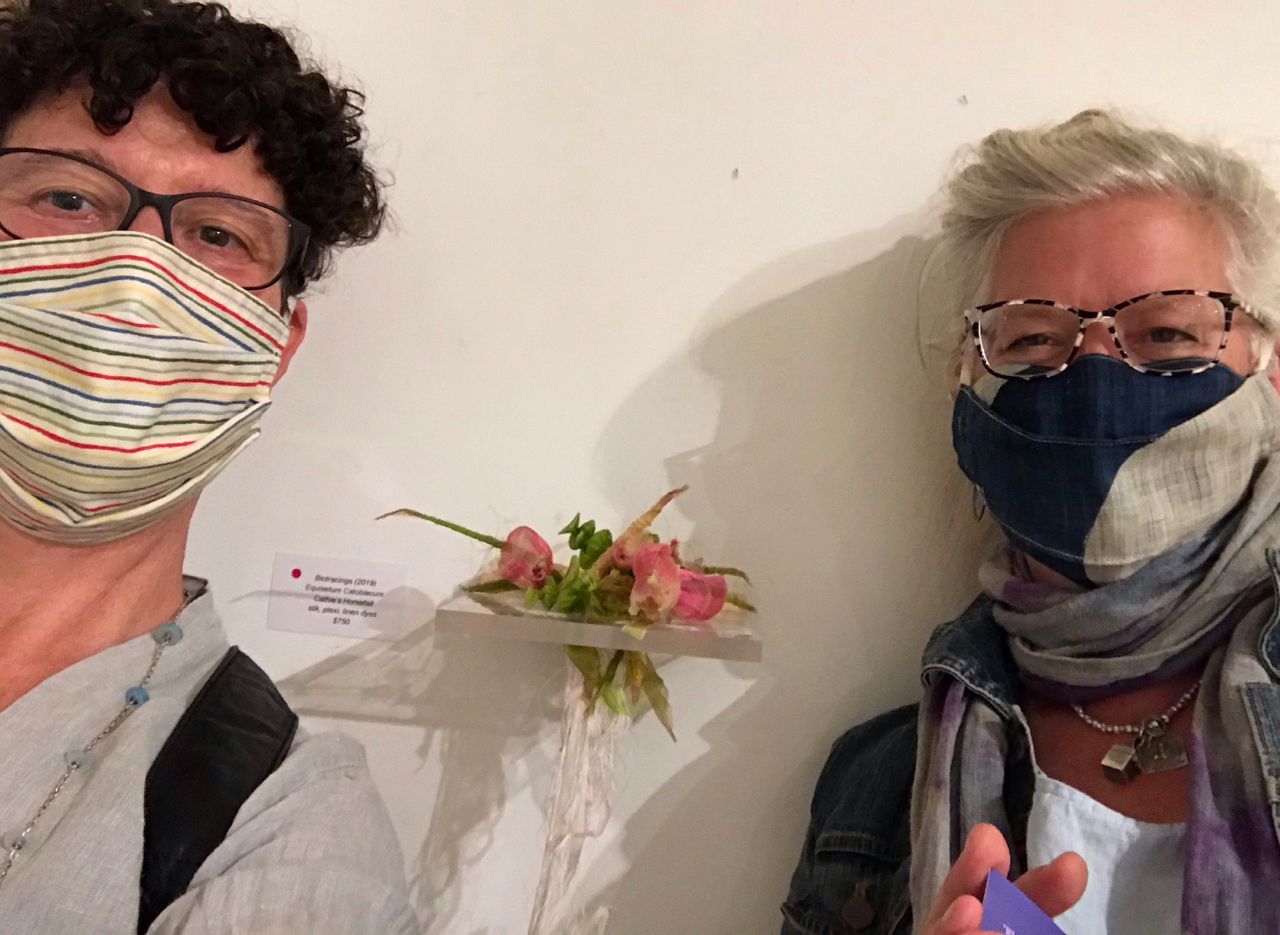
Mary Craig (L) and Rebecca Cross at the opening of Rebecca Cross -- Ephemera at BayArts on October 9, 2020. With Equisetum Catiblecum, Cathie’s Horsetail, 2019. Mixed Media. 

Rebecca Cross -- Ephemera at BayArts in Bay Village, Ohio. Through November 3, 2020.

Many thanks to Radar editors Rachel Marie Patterson and Dara-Lyn Shrager for inspiring work by offering this contest and running it in an attentive and affirming way.

Most of the poems in this set emerged as responses to exercises in online workshops I've taken at the Poetry Barn. Since 2016, as an emerging poet, I've learned foundational skills in meter and form, as well as wide-ranging exposure to compositional concerns, free verse, and reading (women) poets with Joshua Davis. In 2020, I took two generative courses with Amie Whittemore. In between, there have been many courses with a range of instructors, including the Poetry Barn's tireless director, Lissa Kiernan. I am grateful for the encouragement, caring, and expertise shared so generously in this community of poets.

Every poem has an underbelly of where it came from, what soil it drew nourishment from. I learned the gigan form, used in "Dendrochronology" and "Simon's Piñata," in Josh Davis' course called "Rattling the Cage: Forms and Repetition." American poet Ruth Ellen Kocher created the form, and I was drawn both to its manner of containment (16 lines, with a set pattern of couplets and tercets: 2-3-2-2-2-3-2) and its use of repetition that turbo-charges the repeated elements by bringing them together. With room for slight variation, line 1 becomes line 11, and line 6 directly follows it as line 12.

"Dendrochronology" is preoccupied with the return of prolific life in the spring against the stark absence of the child. I wrote the poem during a workshop on meter, using the amphibrach (da-DA-da) counter to its common sing-song in forms like the limerick, and casting it as a breathless heartbeat in two metrical feet per line. The gigan's groupings and repetition contain difficult emotion and confront the inescapability of loss.

Although I wrote the poem many years later, "Simon's Piñata" came out of the very real juxtaposition of Simon's 6th birthday with our travels to Memorial Sloan Kettering in New York City for treatment on a monoclonal antibody trial in 2003. Again, the gigan form offered a means of holding these contrasting events together.

I wrote "Endurance" as a challenge I proposed to the Poetry Barn community in 2018, having seen Brenda Hillman's intriguing, formula-based poem "Micro-minutes on Your Way to Work." The formula: 24 lines, 6 syllables per line. Again, the form presents a means of redirecting my mind as I work, leading to discoveries and choices I might never have found without the "requirement" to seek words that "fit."

"Perigee" is this year's poem, drafted in May during a workshop with Amie Whittemore and revised in August during a second workshop with Amie, where we attended to Gregory Orr's taxonomy of Naming, Singing, Saying, Imagining as ways of "making words come alive." The event that triggered the poem remained vibrant, and the poem evolved through time and attention and insightful input from workshop members.

Before sending my set of poems to Radar Poetry for consideration, I took advantage of the Poetry Barn's newest offering: mentoring. Josh Davis, whose depth of knowledge, support and friendship is deeper than I can swim, offered wise guidance on narrowing the set, believing in the language, and letting the poems go.

Friday, August 24, 2018

A poem published today

I'm pleased to share news that my friends at the Poetry Barn noticed a poem I'd recently revised and asked me if I'd like to submit it for publication in their community zine, the Poetry Distillery. Of course!

I've taken online poetry classes there for nearly three years now, exploring form, meter, elegy, image, revision, women poets, the ode. This particular poem, Dear Hope, Although, emerged in response to a comunnity-wide prompt: write a letter to hope. The circumstance described in the poem had just occurred, and so did the poem.

When I had another look at my original stanzas, I found the poem "explainy". I cut away extraneous bits and reduced the stanza from quatrain to tercet. Now I have a poem where my practice with compression, image, line breaks, rhythm, and sound comes to bear.

I haven't posted much since my attention has turned to poetry. One reason is that I've taken the conversation "underground" into my coursework. Another is that many publishers refuse poems that have appeared on the internet in any prior form. To avoid that conundrum, I'm keeping my unpublished work off my blog.

That said, someone might be interested in this poem's evolution. Here's the original draft I wrote and shared "in the moment" late in 2015. The revised poem sheds 61 of these words while keeping the poem's spark. Comparison of the two is a good measure of how much I've been reading and writing to find my way into poetry.

Again, the published version is Dear Hope, Although.

For fun, here's the original (not terrible) draft:

[Dear Hope, although]

Dear Hope, although
you and I have become
estranged, I write with
something of an inkling.

Picture this: in early light
I wake up with my left hand
on my right breast, scratching.
As consciousness returns,

the burn of insect travels
from nerve to brain.
On my nipple?
Fear of vulnerable tissue

hardening into a welt
stills my hand. Instead
my nails discover a trail
of bites--mosquito? in December?

After supping on my arm,
it must have walked, pausingly,
across my upper back, rounding
my collarbone to crawl under.

On thread legs, the invader
stumbles tipsy across my nipple's
cobbled surface, leaving
a tiny chemical pebble

I can feel but cannot see.
I scratch the other sites
bloody but find forbearance
to leave my breast alone.

And that is why, Hope,
as December ends
I return to you. If I can
not scratch that bite

of deepest invasion,
what else might I hope
to accomplish in a
brand new year?

Sunday, February 14, 2016

A published poem! (Barcelona Notebook #4)

Happy Valentine's Day! I've had a poem published in Vox Mom (Mom Egg Review) in a collection on the theme: LOVE OF IDENTITY/IDENTITY OF LOVE, curated by Sharon Dolin. If you would like to see the poem without further introduction, head right here (mine is number three).

My poem, Face card: Queen of Shadows, is a Barcelona poem from June 2015. On day eight of the workshop, we went to the Museu Picasso to see Picasso - Dalí   Dalí - Picasso, which paired works by the two artists at various stages of their careers. Sharon Dolin had sent us off with the suggestion to write a poem in a form. She offered the cinquain as a starting point. Five-line stanzas with the following syllable counts: 2, 4, 6, 8, 2. Here's a self-explanatory cinquain.

Syllable Game

first two
then double that
another pair makes six
now stretch the line way out to eight
and back

I was taken by an early Dalí portrait, paired with a somewhat earlier one by Picasso. Dalí reworked his portrait after meeting Picasso for the first time in 1926. To see the effect of Picasso on Dalí, follow this link and scroll in EXHIBITION until you find a page that looks like this:


There you will see Dalí's Portrait of My Sister (1923) on the right, as I saw it in the museum in June, paired with Picasso's neoclasical Portrait of Olga (1917).

The primary gesture of the poem "wrote itself" as I stood in the gallery, making notes and sketches. I turned it into a cinquain. My poem has four stanzas of five lines and follows the syllable pattern (with one change inspired by the portrait's shape).


Dalí's painting is owned by The Dalí Museum of St. Petersburg (Florida). Interestingly, this museum presents the painting on its website the other way around, with the "older" face on top. While the frustration of the mentee/mentor relationship between the two artists may be at the heart of the aggression I sense in the painting, it may also come from tension between the two siblings, as the St. Petersburg site suggests.

I've learned a bit more about the cinquain. The originator of the 22-syllable stanza was Adeleide Crapsey (1878-1914). Her cinquains are one stanza long and have a quality of the tanka or haiku. My poem is its own version of the cinquain, an enjoyable syllable game.

Friday, February 12, 2016

The Great Poetry Disruption (Barcelona Notebook #3)

Readers of Chapter This may have stopped wondering what happened to this blog. Where did it go after an intense daily series in the month of May, scattered postings over the summer, then silence since September?

The answer (more or less) is poetry.

In June of 2015 I joined a 10-day workshop called Writing about Art in Barcelona with poet/instructor Sharon Dolin. In fact, I attempted to start an occasional series on this blog to report on the experience. I made it to Barcelona Notebook #2. I chose the workshop for two reasons. 1) I wanted to return to Barcelona, a place I had visited with my one-year-old son 17 years earlier, when he was a healthy little guy and life felt lucky. This Barcelona visit was a way to honor his memory at the time of his 18th birthday, a decade since his death. 2) I wanted to write about art and memory in Barcelona.

Jiwar reading room
June 2015
I planned to write in prose, although I knew the workshop would focus more on poetry.  During the ten days, we visited a plaça with a bomb shelter; Gaudí's Parc Güell; museums dedicated to Miró, Picasso, and contemporary art; Gaudí's Casa Batllo. We toured an artist's studio, met a Catalan poet.

Each day at the Jiwar center, we workshopped the previous day's work and discussed a new assignment. We learned about different ways to consider ekphrasis, i.e., writing from art, and Sharon's taxonomy of ekphrasis was exhaustive and inspiring: describe an artwork, write of the artwork without explicitly saying you are doing so, talk of art-making, write of museum experience, give an artist's portrait, and so on. A handy basic reference is Art and Artists: Poems, edited by Emily Fragos.

View from Parc Güell
over Barcelona

Before we left for each day's outing, Sharon also offered guidance on a particular poetic form to try. For example, when we visited the sprawling, inventively tiled Parc Güell, she suggested we write in a mosaic way. On another day, she suggested we write a poem in a strict form (a cinquain, or perhaps a villanelle). The six of us - five participants and Sharon - scribbled in our notebooks, snapped photos, and walked around with our eyes in the clouds. Sometimes my husband and daughter joined us on these excursions. (If you ask my daughter, we all looked pretty weird.)

Everyday, I produced a poem. I did not write prose. Over the 10 days, my poems progressed from idea-laden prose-like texts (with line breaks) to something freer, more playful, and somehow much less. That is, I began to see that despite the many ideas wanting to crowd their way in, I would find the heart of the poem when I left most of the "stuff" out.

It seems I've lost my head. Take a look at my posts July-September 2015. The anniversary of Simon's death and some dragonflies yanked me back to memoir/prose, but otherwise the impulse to write in verse has become powerful and, well, disruptive. I posted a few poems. I even posted about being confused about writing in verse or prose. In the "back end" of this blog, I count seven draft posts along my "old" lines over the past six months. Unfinished, unposted.

I've been busy, and, I promise, I'll be back.

Tuesday, August 18, 2015

Being present (flash post)

Keeping to my own rules for a flash post (write it fast, almost no editing), I came home needing to write a little scene. I jotted it down by hand because I had a pot of soup to start, and then I came to my computer to blog. And here's what happens: I start to wonder if I need to break the lines. Is this supposed to be a poem?

Today's result is two poems. The first is a prose poem. The second, a lined poem. Each form, of course, drives different choices. Editing today is a particularly astute process because I've re-read Strunk and White's Elements of Style for an article I'm writing. Still not done, but this is a flash post! Since there are two versions of the "same thing," your are welcome to vote on your favorite!

I.

Walking away from the small town supermarket this evening, past the outdoor fruit display, past the cluster of middle-aged cyclists paused in front of Town Hall, weaving aside for pedestrians, I saw a lady walking toward and past me. She smiled warmly as as she said, "See you soon," into her phone, and I wondered if I'm ever that genuinely pleased. Certainly not on the phone, because I dislike talking on the phone. But ever in my life? Do I inhabit a moment with such generous appreciation? I grasped at my bike helmet to open the strap and rounded the corner toward where I had left my bike. And in the moment of asking do-I-ever a radiant field of magenta burst into view--a flower box plump with petunias hanging from a window of the old Rathaus. Sensory pleasure filled the air like the chimes of shimmering bells.

II.

Walking away this evening
from the small town supermarket
past an outdoor fruit display
side-stepping pedestrians
past a cluster of cyclists

I saw a lady walking toward
and past me who smiled warmly
as as she said, "See you soon,"
into her phone, and I wondered
if I'm ever that genuinely pleased.

Certainly not on the phone
because I dislike talking on the phone
but ever in my life?

Can I feel a moment like that?

My fingers undid my bike helmet strap
I turned a corner
and my eyes filled

with radiant magenta--
an effusion of petunias
hanging from a window
in the old Rathaus

like bells chiming shimmery tones in every
molecule of the air.


Monday, September 15, 2014

Ten lines of iambic pentameter or Shakespeare in the morning

In June I heard a writing prompt from poet Ellen Bass: start the day with ten lines of iambic pentameter. You know, the meter of Shakespeare's sonnets (fourteen-line poems following a rhyme scheme and ending with a rhyming couplet) and most of the lines in his plays (blank verse generally without rhyme).
da-Da da-Da da-Da da-Da da-Da
English doesn't always divide neatly into pairs of unstressed and stressed syllables, however. A famous example might be
To BE or NOT to BE that IS the QUESTion
WHEther 'tis NOBler IN the MIND to SUFfer
The SLINGS and ARrows OF outRAGeous FORTune
Or to TAKE ARMS aGAINST a SEA of TROUBles,
And BY opPOSing END them? To DIE, to SLEEP—

The first four lines of Hamlet's soliloquy end with unaccented syllables that exceed the official iamb pattern (short long). Only in line five, on the word "sleep," does metric clarity briefly emerge. I see a trochee (long short) in "WHEther," reversing the stress pattern, and an anapest (short short long) in "Or to TAKE ARMS," giving the passage additional variance that is common to the form. Wikipedia has helpful entries on metrical feet and prosody. I'm somewhere near the beginning of my understanding.

Looking at Shakespeare's sonnets, I'm sometimes unsure where the five stressed beats fall. The same thing happens when I write in iambic pentameter, a task that may be more difficult in modern English than in Shakespeare's time. For example, he makes use of a spoken difference between "rhym'd" and "rhymed" and of truncated words like "wher'er" to tailor the text.

Here are some sonnets that caught my eye today. The final example (CXXIX) was my favorite back in high school English class.

                         XCVIII.
From you I have been absent in the spring,
When proud-pied April, dress'd in all his trim,
Hath put a spirit of youth in everything,
That heavy Saturn laugh'd and leap'd with him.
Yet nor the lays of birds, nor the sweet smell
Of different flowers in odour and in hue,
could make me any summer's story tell,
Or from their proud lap pluck them where they grew:
Nor did I wonder at the lilies white,
Nor praise the deep vermillion in the rose;
They were but sweet, but figures of delight,
Drawn after you, you pattern of all those.
     Yet seem'd it winter still, and you, away,
     As with your shadow I with these did play:
                           XCIX.
The forward violet thus did I chide;--
Sweet thief, whence didst thou steal thy sweet that smells,
If not from my love's breath? The purple pride
Which on thy soft cheek for complexion dwells,
The lily I condemned for thy hand,
The roses fearfully on thorns did stand,
One blushing shame, another white despair;
A third, nor red nor white, had stolen of both.
And to his fobbery had annexe'd thy breath;
But for his theft, in pride of all his growth
A vengeful canker eat him up to death.
     More flowers I noted, yet I none could see,
     But sweet of colour it had stolen from thee.

                          CXVI.
Let me not to the marriage of true minds
Admit impediments. Love is not love
Which alters when it alteration finds,
Or bends with the remover to remove:
O no; it is an ever-fixed mark,
That looks on tempests, and is never shaken;
It is the star to every wandering bark,
Whose worth's unknown, although his height be taken.
Love's not Time's fool, though rosy lips and cheeks
Within his bending sickle's compass come;
Love alters not with his brief hours and weeks,
But bears it out even to the edge of doom.
     If this be error, and upon me prov'd,
     I never writ, nor no man ever lov'd.

                         CXXIX.
The expense of spirit in a waste of shame
Is lust in action; and till action, lust
Is perjur'd, murderous, bloody, full of blame,
Savage, extreme, rude, cruel, not to trust;
Enjoy'd no sooner, but despised straight;
Past reason hunted; and no sooner had,
Past reason hated, as a swallow'd bait,
On purpose laid to make the taker mad;
Mad in pursuit, and in possession so;
Had, having, and in quest to have, extreme;
A bliss in proof,--and prov'd, a very woe;
Before, a joy propos'd; behind, a dream;
     All this the world well knows, yet none knows well
     To shun the heaven that leads men to this hell. 

And what's a prose writer like me to do with this prompt to write in iambic pentameter? In July I shared one "10-lines" exercise that became a pumpkin sonnet. Any good exercise gets writing and observing and thinking motors to move--a lot like practicing an instrument or looking at paintings. Perhaps "10-lines" is an hour of yoga. Summer vacation turned out to be a low writing time for me--with my focus more on family time, travel and visitors. I got some translation work done and read a bit, but my writing gears cranked minimally.  Yesterday, taking a break from the lesson plan I need to write, I pulled the exercise out again, scooted my chair over to the window, put my journal in my lap, and forged lines. Nothing came easily, but I urged myself line-by-line to come up with ten lines. It worked. I wrote eleven lines. Technically I was writing from memory, but looking out the window at the deck helped me recreate a brief sighting from the day before. The rhyming "happened," and I didn't like it better when I pushed for more rhymes, so I left the text the way it emerged. As ever, I marvel at the possibility in words. Poetry demands awareness on about a million levels. I'm thrilled when I can get a few levels going.

A stately swirl of beige with mauve and brown
adorns a shining carriage, light and round
as a ping-pong ball that’s poised an inch above
the rain-filled rills, appearing not to move
out there across the soggy wooden plank.
Sunlessly pale a narrow tail lies still.
What sign, then, of motion, purpose, life?
Slug-snail, are you crossing such a vast
expanse to reach my garden, munch my plants?
Two rubbery antenna pairs turn right
turn left, turn right, point straight: the creature’s pace.

Sunday, July 27, 2014

Dishwasher sonnet

Following up on First bloom! Pumpkin sonnets, here is my "dishwasher sonnet" written in 2008 when I was in Tim O'Keefe's Intro to Creative Writing at the University of Utah. I believe we got more poetry instruction in Tim's version of the class than in most. I came away from the class with a healthy sense of how little I knew about poetry. Over the years, I've had further conversations with Tim, and my general sense is I still know precious little about poetry. However, the impulse to write and think in the way of poetry continues for me, and my sense of what's possible grows over time.

One assignment was to write a sonnet. We had freedom in terms of the form: rhyming or not rhyming. I believe we were encouraged to keep to fourteen lines and to use iambic pentameter. I wrote an ABAB CDCD EFEF GG "traditional" rhymed sonnet in "I grow a pumpkin aching back to you". My second sonnet uses an invented scheme. It's also precise, but I recall there was only one class member out of about twenty who actually spotted it.

So, readers of Chapter This: what's the organizing scheme? Make your guesses in comments here on the blog or over on facebook.

Because I couldn't leave it alone, I revised the poem slightly today. Here are both versions. (Hint: the scheme did not change.)

Endless Cycles (for Barbara) (2008)

Done for now—I can do no more.
Reach and grasp and stack and stow the same
Milkwhite stonegrey implements—enough.
Fan from the dishes any wet pools and place
Solitary the ones that drip or spill.
Labyrinthine task at last complete—
Time of emptiness scarcely seems to find
Dominion—a Ferris wheel poised
        at highest height
Tilts and topples, its yawning void for all
Languishing glassware, bowls, encrusted stacks
Soldierlike returning in order stiff
Fast inhabiting briefest empty room
Miringly filling ’til fullness ends the chore.
Re-poured soap, closed door, pressed knob I stand…

                                 * * *

Endless Cycles (for Barbara) (2014)

Done for now—I can do no more:
Reach and grasp and stack and stow the same
Milky whites and stainy stainless—enough!
Fan the wetness pooled in grooves and place
Solitary whatever drips to dry.
Labyrinthine task at last complete;
Time of emptiness scarcely seems to hold
Dominion—a Ferris wheel poised
        at highest height
Tilts and topples. The void invites return.
Languishing glassware, bowls, encrusted stacks
Soldierlike returning in order stiff
Fast inhabiting briefest empty room
Miringly filling ’til fullness ends the chore.
Re-poured soap, closed door, pressed knob I stand…

Thursday, July 17, 2014

First bloom! Pumpkin sonnets

Yesterday evening, the pumpkin plant's first buds looked full and yellow and ready to burst.
July 16, 2014 about 9:00 pm

July 17, 2014 about 9:00 am

I took inspiration for my morning writing from the pumpkin plants and the new flowers. "10 lines of iambic pentameter," I though to myself, "that will be easy." I've written about the pumpkin for so many years now. I figured sitting on a stool with my notebook right beside the plant would allow me to write freely and quickly. After a good forty-five minutes, I went inside to my computer with one scratchy page of writing--too scratchy even to count lines accurately.

I typed and redrafted extensively at my desk, all the while feeling less certain that the effort and time put into the exercise made any sense at all. I'm still not sure. But I have fourteen lines, some of which push boundaries of iambic pentameter past where I can comfortably evaluate them. Multi-syllable words and shifting emphases (anapests, trochees, dactyls and anything else that feels differently weighted) are a challenge. On the other hand, I've wanted to push past relying on one-syllable words connected by articles, conjunctions and prepositions. So, I give you fourteen lines of iambic pentameter, vaguely in the form of a sonnet.
[First bloom] 
Broad green leaves, part maple-shaped, part heart,
cleft and round where hollow stem meets veins
of beige that branch and re-branch to each leaf’s edge,
shade-making, dew-holding, chlorphylled veil,
a membrane lofty, thin and brave, prepares
to be sustenance for fruit that’s yet to come,
to shelter it from heavy rain and sun,
transforming light and air to feed new buds
now bursting through the calming cover of leaves
like jesters’ hats of wrinkled orange-gold.
They beckon flying creatures to come and coat
their bellies and bee-hinds in yellow powder
    then buzz away to roses, phlox or cat-mint—
    too soon to find and bless a pumpkin’s mate.

The first pumpkin nectar for bees in 2014.

July 17, 2014 First potential pumpkin of the season,
with adult human female toenail for scale comparison.

I recalled today that I wrote a sonnet about the pumpkin in 2008 while taking Tim O'Keefe's English 2500 Introduction to Creative Writing at the University of Utah. I was forty-five years old in a mostly undergraduate-aged class. I believe it is fair to say I cut my teeth in Tim's class. The pumpkin sonnet was my back-up, and the class much preferred my much less traditional dishwasher sonnet. (If I hear any requests, I'll post the dishwasher sonnet, too.) From February 2008:
[I grow a pumpkin aching back to you] 
I grow a pumpkin aching back to you,
My dear sweet child, my babe, my first-born son.
A sprouted seed held in a cup it grew—
At first we let it languish without sun.
Yet something urged me plant it in the earth
To carry on what school friends had not doubted
By sticking pumpkin seeds in soot-brown dirt
And watching awestruck as each green shoot sprouted.
Bent-backed, broad-leaved it crawled on thick-vined knee:
Straight toward your sick room restlessly it tore
As if wild growth could ease your agony.
One fruit all golden, full and round it bore
    That you might live beyond your seventh year
    And I, the tender, hold you thus still near.

Monday, June 30, 2014

Poetry addendum to Learning from Ellen Bass

Yesterday I linked to Seema Reza's page, where I posted poem ideas within the comments of a prompt she posted. I thought I'd also post them here.

Original draft, June 8, 2014
Precise black nibs, air-filled and
separate, top jaw flopped wide
I contain a gathering of long-sleeves
along on a summer trip, the other
shoes, embroidered vest, crinkled receipt.
I await repacking for a multi-flight
return; my teeth will perform their
miracle against the odds
and ends I hold while I totter and wheeze
and glide and shudder when you shove me
in that overhead bin. But I will not
be the one flung in the hold below, so there,
bigger bag, so there.
Reworked draft (for shape), approx. June 10, 2014
My precise black tines comb empty air
flat jaw flopping floorward
mine are the long sleeves brought on a
summer trip, embroidered
vest, birthday cards, receipts, the other
shoes. My tiny hooks yield
one by one—a corps de ballet—we are
a miracle against the odds
and ends I hold. I’ll glide, stand, topple
and shudder at your shove
in that lunchbox overhead. But I’m not
the one who’ll be flung on
a belt towards a crushing, frigid pit. So
there, bigger bag, so there. 
In my notebook, I also found this embryonic text, fed by poetic impulses and written June 8, the day the conference ended. 
In my writing I seek Simon
a boy who would not be little now
whose voice could be gravel or stew
or honey like his father's
who would know private things
he'd not tell me
who would sweat and lust
adultly arms and groin and growingly seek to leave
yet still be one I can't keep my
eyes from, one whose sleep
I watch like drinking wine
whose calmed face reminds of the
tiny closed eyes, the mouth
owning my nipple.

Monday, January 14, 2013

Poetry experiment

Here's a follow-up on yesterday's semi-poem. I call myself a prose writer, but every now and then something with shorter lines or a poetic gesture emerges. For example, I took a walk to the bakery on Sunday morning and made this Facebook posting when I got back.

Frozen morning: crunching opaque ice membranes stretched over ruts in the path is fun like popping bubble wrap only entirely more musical.

Several friends clicked "like" and commented. Amy Sheon saw the haiku potential here, which I, too, had noticed during another walk late afternoon. A haiku's brief 17 syllables seemed a challenge; I had a lot more words. So, I looked for "that other" Japanese short syllabic poetry form that I vaguely recalled. I searched on "haiku and" with immediate results: Haiku and Tanka courtesy of the Virtual Museum of Japanese Arts presented by the Japanese Ministry of Foreign Affairs.

You can follow the link yourself to find a charming presentation about the forms, but here's the basic information. Haiku is three lines, syllable pattern 5-7-5 (a total of 17 syllables). Tanka has five lines with the syllable pattern 5-7-5-7-7 (31 syllables). I have written one of each, essentially simultaneously, taking off from my original observation and wording. I have allowed myself a 4-syllable title, and I don't know if that's breaking form or not.

I imagine that writing syllabic poetry in Japanese feels quite different from English. The Japanese equivalent to an alphabet is a "syllabary." It's a system of syllables ordered by initial consonant, each ending in one of five vowels. The exception is final "n", which also counts as a syllable. For example, the word "haiku" counts as three syllables: ha-i-ku. "Tanka" is the same: ta-nn-ka. English pronounces both words in two syllables.

Soundwise, Japanese reminds me of Italian, with all those words ending in vowels (a fact that appears to make rhyme schemes in Italian ever so much simpler). I look at a lengthy one-syllable English word like "stretched" and imagine syllables in Japanese to be more obvious, more like breathing. I need my tapping fingers. (That's a 7-syllable sentence right there.)

Tanka

Frozen morning

crunching opaque ice
membranes stretched in rutted path
is fun like popping
bursting sheets of bubble wrap
ethereal chimes in ice


Haiku

Frozen morning

crunching opaque ice
rutted path of bubble wrap
joyful winter chimes


A previous winter moment prompted my other recent haiku. Now there are three of these poems. I believe I may be working my way toward a page of poetry on this blog.

Snow haiku, December 7, 2012

snow tumbling through air
downward halting plunging spread
outside my warm room

From another frozen morning during a horse-driven sleigh ride with Austrian relatives, January 2011. (c) Mary Craig