Thursday, July 17, 2014

First bloom! Pumpkin sonnets

Yesterday evening, the pumpkin plant's first buds looked full and yellow and ready to burst.
July 16, 2014 about 9:00 pm

July 17, 2014 about 9:00 am

I took inspiration for my morning writing from the pumpkin plants and the new flowers. "10 lines of iambic pentameter," I though to myself, "that will be easy." I've written about the pumpkin for so many years now. I figured sitting on a stool with my notebook right beside the plant would allow me to write freely and quickly. After a good forty-five minutes, I went inside to my computer with one scratchy page of writing--too scratchy even to count lines accurately.

I typed and redrafted extensively at my desk, all the while feeling less certain that the effort and time put into the exercise made any sense at all. I'm still not sure. But I have fourteen lines, some of which push boundaries of iambic pentameter past where I can comfortably evaluate them. Multi-syllable words and shifting emphases (anapests, trochees, dactyls and anything else that feels differently weighted) are a challenge. On the other hand, I've wanted to push past relying on one-syllable words connected by articles, conjunctions and prepositions. So, I give you fourteen lines of iambic pentameter, vaguely in the form of a sonnet.
[First bloom] 
Broad green leaves, part maple-shaped, part heart,
cleft and round where hollow stem meets veins
of beige that branch and re-branch to each leaf’s edge,
shade-making, dew-holding, chlorphylled veil,
a membrane lofty, thin and brave, prepares
to be sustenance for fruit that’s yet to come,
to shelter it from heavy rain and sun,
transforming light and air to feed new buds
now bursting through the calming cover of leaves
like jesters’ hats of wrinkled orange-gold.
They beckon flying creatures to come and coat
their bellies and bee-hinds in yellow powder
    then buzz away to roses, phlox or cat-mint—
    too soon to find and bless a pumpkin’s mate.

The first pumpkin nectar for bees in 2014.

July 17, 2014 First potential pumpkin of the season,
with adult human female toenail for scale comparison.

I recalled today that I wrote a sonnet about the pumpkin in 2008 while taking Tim O'Keefe's English 2500 Introduction to Creative Writing at the University of Utah. I was forty-five years old in a mostly undergraduate-aged class. I believe it is fair to say I cut my teeth in Tim's class. The pumpkin sonnet was my back-up, and the class much preferred my much less traditional dishwasher sonnet. (If I hear any requests, I'll post the dishwasher sonnet, too.) From February 2008:
[I grow a pumpkin aching back to you] 
I grow a pumpkin aching back to you,
My dear sweet child, my babe, my first-born son.
A sprouted seed held in a cup it grew—
At first we let it languish without sun.
Yet something urged me plant it in the earth
To carry on what school friends had not doubted
By sticking pumpkin seeds in soot-brown dirt
And watching awestruck as each green shoot sprouted.
Bent-backed, broad-leaved it crawled on thick-vined knee:
Straight toward your sick room restlessly it tore
As if wild growth could ease your agony.
One fruit all golden, full and round it bore
    That you might live beyond your seventh year
    And I, the tender, hold you thus still near.

Sunday, July 13, 2014

Windy Sunday afternoon ride (flash post)

I was back on my bike this afternoon, and I took Markus along on a jaunt through the vineyards and fields southeast of Flein. Grapes are a-growing: bushy plants and small, hard-looking fruit. We saw fields of rapeseed (some harvested), corn, wheat, rye, strawberries, and raspberries.

Up along the southern edge of the vineyards, we passed the big red frame, Flein's outdoor "movie theater." The color has faded considerably since we first encountered the frame in 2010. The photo shows Miriam and me with both sets of grandparents. A lot has changed. For one thing, Miriam's several inches taller than me now.

Open Air Cinema of Flein, where we are encouraged
to stop, rest and watch the world go by (October 2010)
Markus and I found the "Ausschank" open. It's a hut out in the fields that serves wine and snacks on Sunday afternoons in the summertime. We stopped for a glass of Sekt and a cheese sandwich and chatted with our across-the-street neighbors. We learned a lot about the history of Flein. They came in 1958 when the population was 3,000. We came in 2010 at 6,500. Now it's 7,000 and growing. (The three of us weren't the only new arrivals.)

On the downhill straightaways toward home, I coasted through the wind with my loose linen top flapping against my back and sides like a fabulous torso massage. More than enough reward for the bramble scrape on the back of my hand and the dead-ends, gravel sections, and pant-inducing uphills.

Now we look with all of Germany toward tonight's action in Brazil. I'm glad (after the USA left the World Cup) to have a decent back-up team to cheer for. We're already drinking more Sekt.

[Sekt is sparkling wine that's made like champagne, but it's illegal to call it champagne because that's a protected name. Our bottle tonight is rosé, from grapes grown around about where we were biking today.]

Deadheading (flash post)

I think (in the garden)
therefore I blog

Today's project: cutting back the dried up blooms in my flower bed before they go all the way to seed. The practice, known as deadheading, is one I learned from my mother, who found she could assign me to the pansy bed and ask me to pinch off the wilted flower heads with their thin stems. Pansies, she told me, are called "little kitten face" in Chinese. Sometimes I filled tiny vases with pansy bouquets. Generally, I objected less strenuously to this task than to others, such as yanking out the ivy runners infiltrating the lawn to prune them back. "If that's so important to you," I spat in preteen indignation, "then do it yourself!" (The line requires exiting at a run. Apparently, I still feel a little bad about it.) 

My mother's connection to China goes back to her birth in Suzhou, where her parents served as Methodist missionaries until they fled the Japanese invasion in 1939. Her connection to deadheading comes from her father, primarily, who gardened in the yard around my grandparents' Tenafly, New Jersey home. The deep, shady backyard was a late spring paradise of blossoming dogwood, impatiens, azalea, and rhododendron: white, pink, salmon, and red against lush green and delicate tree bark.

My main backyard activity in Tenafly was the trolly swing Gramp hung across the full width of the yard behind the house between two tall trees. With handles and a seat, the trolley hung as a vertical line from a metal wire and ran on two grooved wheels, making a squealing noise as the rider went forward toward the opposite tree at high speed and backwards, slighly more slowly, to the start. At that point we had to hop off and give the next sibling or cousin a turn to climb up the step ladder and hop on. 

The other backyard pleasure was a cloth hammock strung between two trees perfectly distant from one another. Alone, or with a companion, we rocked back and forth. We played ship. We wrapped ourselves completely within the darkness of the fabric and let ourselves be flipped round and round from the outside. Over time, Gramp noticed we had caused the sturdy S-hooks to bend out of shape.

I expect we ate corn on the cob and spat watermelon seeds into the bushes. I bet we played tag and croquet. But what I remember is the trolly, the hammock, and the impressionist painting look of the grove of blooming bushes and trees in early summer.

The point of deadheading, according to Gramp as my mother tells it, is "to frustrate the plant." That is how you keep it blooming, keep it working toward its reproductive mission. Even my snail-nibbled, mildewed yellow coreopsis will bloom longer after I've trimmed these browned stubs back.

Coreopsis, pre-deadheading.
Gramp also advised removing suckers from plants, like the side branches on tomato plants that steal energy from the primary fruit-bearing stems. They look a little like a new arm trying to grow out of an armpit. The biggest pumpkin plant has a few suckers already, but I'm leaving them alone. The plants are tenuous this year. Maybe that would be an argument for eliminating side spurs. At this point, I'm eager to see survival, so I will let them be. Ten years ago, in the inaugural summer of Simon's pumpkin, the ur-pumpkin was already bigger than a softball by mid-July. There's still time before the fall frosts, of course, but I'd say this is the week for these plants to act like the garden is all theirs.

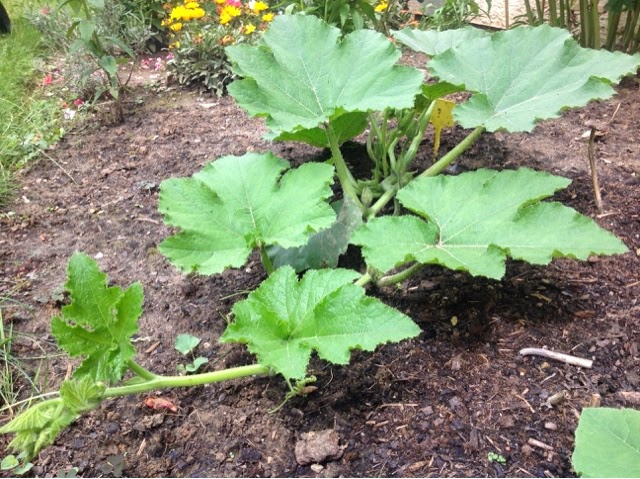
The biggest pumpkin plant, growing one leaf at a time.

Sunday, July 6, 2014

Signs of maturing (flash post)

I've been watching these pumpkins grow for ten years now. My perception grows more specific with time. The first year, 2004, I would notice things after the fact. Oh, the plant has shot a vine along the fence toward the house. Oh, the leaves are all wilted from the heat. Oh, the blossoms are a lovely shade of orange-yellow. Oh, there's a globe shape with watermelon skin resting on the grass.

Now I peer at the plants the way we watch infants for their every change of expression. Here's what I can see today.

"?" remains the frontrunner by a considerable lead.
The long vine has begun to shift from upward growth and will soon rest
on the dirt. The plant means business once it starts sending out
the curling tendrils that will help it grab on.
"?" in close-up. Thin stalks and tight buds show the lanky male flowers
preparing to bloom later. The female flowers have yet to emerge
out at the end of the growing vine. The first two round-edged leaves
from the sprouting seed have begun to dry and drop off the plant.
2011 getting situated.
2012 the runner-up, size-wise, but it still has those first two rounded leaves.
2004 (a) making progress.
2004 (b) growing roots for sure.
Maturation is on my mind. I see that in my poetry fragment about Simon reaching an imagined maturity. I see it when I think of the cousins Simon's age, leaving high school or entering senior year in the fall, as Simon would have been set to do. With amazement I see that I've repeated a pattern in my teaching life. In Salt Lake City, I began teaching middle school (5th-8th graders) a year after Simon died. I thought the children, being much older than Simon, would not remind me painfully of him. The years went by, and soon I was teaching his own age group. I had a group of 7th grade mentees, all born around 1997, like Simon. Now, I teach college students. Most of the students enter straight from high school. In the fall of 2015, the entering class will be young adults the same age that Simon would be.

Friday, July 4, 2014

Learning from Michael Martone

I first heard of Michael Martone in 2010 during a fiction workshop with Melanie Rae Thon at the University of Utah. He was one of the gurus she cited during the course (English 5510) along with John Edgar Wideman, Carole Maso, William Maxwell, John Berger, and numerous others. He has resided among my files as "EXPERIMENT #8: THE MARVELOUS MICHAEL MARTONE." Melanie's exercise suggests re-imagining a common object (like Martone's "Chatty Cathy Falls into the Wrong Hands" story) or a disturbing historical fact (his "It's Time" essay about people hand-painting clocks with radium) or any revision at all using Martone's "remarkable sense of detail as inspiration for your own work."

Experiment #8 was heavier lifting at the time, what with needing to find the Martone texts in the special coursepack in the English Dept. office, so I'm glad it worked out to meet Michael in person at the 2013 Writers at Work conference and to see him again there this year. He's very entertaining, and the lifting is light indeed when you get to listen to him read or talk. He's likely to make you laugh. Pretty hard.

I want to note that I saw Michael Martone and Melanie Rae Thon in conversation during a break in this year's conference at least once, and I realized the situation: both of their names end with the syllable "tone." So, of course. Not that many names do, after all.

Michael Martone, University of Alabama
Website: http://english.ua.edu/user/84*
Wikipedia: http://en.wikipedia.org/wiki/Michael_A._Martone (not the hockey player)
Workshop title: The Four C’s: Cut, Compress, Context and Collage

*a website that appears to contain an actual bio rather than a fictional "contributor's note," however yesterday the site was down and who knows about today?

June 4, Opening Faculty Panel: Why are we writing?

Michael got the conversation going with a reference to William Stafford, who said if you can't write, "lower your standards." Writing is not the same thing as writing in a publishing-oriented way. In fact, Michael deplores the displacement of our sense of the pure value of text. In schools now, children receive coupons for pizza as a reward for reading a book. Not great, Michael says. It used to be that "reading was the pizza."

Michael brought up the "everybody writes" vs. "special people write" divide exemplified by Jack London on the one hand and Henry James and Edith Wharton on the other. He cited critic Frank Norris' dismissal of the "tragedy of the broken teacup" in works such as those of James and Wharton. I located a discussion of this idea in Michael Martone's 2005 book, Unconventions: Attempting the Art of Craft and the Craft of Art. I won't pretend to have read the full discussion there, but I share the title because it's emblematic of the sort of thinking Michael does on a rigorous and regular basis: What can be reversed and thought about completely differently?

The idea of publishing is in flux, Michael says. The old "publication equals validation" equation is fading. Now the "means of production" are in the hands of the writers. The concept of vanity publishing is not the same as self-publishing. Roles are intermixing--writer, editor, publisher--cultural "gate-keeping" is less a power of the publishing industry.

The panel ended with comments about genre specialization being too extreme (Robin Hemley) and Ellen Bass' comment that you're a writer if you're writing and not if you're not. Michael gave a push for innovation: look for a new way everyday; the greater culture expects progression.

What I learned about Michael's workshop from my "spies"

As with the fiction workshop, my infiltration of the multi-genre workshop was somewhat desultory. I knew from friends on the inside that things were interesting and fun, but exactly what they were up to, I can't say for sure.

One day at lunch, Chelsea Blackman walked through the dining room with a handful of paint samples, four colors on a strip of paper. She was distributing them for an exercise in the Martone workshop. “I’ll take one!” I said, greedily. I love colors, and paint swatches are a great place to look for color names. So is the Wikipedia List of colors (although it’s alphabetical, not by actual color, which can be tedious) and the Wikipedia List of Crayola crayon colors (which is a trip back into deep memory).

What I forgot to do was ask about the exact assignment. I expect Michael had something specific and perhaps counterintuitive in mind. Nonetheless, I’ve done the exercise. I did it this way: use all four color names in a text. What I enjoy about this sort of prompt is the way it challenges me to imagine things I've never seen before and to play them out for a little while. Here's my text.
Luncheon 
A silver half dollar, soldered on the underside to an unseen ring, gleamed from its perch atop the rolled cloth napkin, next to a setting of silver salad fork, fork, empty white plate with dimpled rim, knife, and soup spoon. A Kennedy profile, staring off to the left: round and round the table, the Kennedy napkin rings stared. 
The napkin, sharply pointed top and bottom, slid out from the ring and opened as a white diamond, corners folded toward the middle like envelope flaps. A veritable lap robe, so large and crisp and white. 
Tall cylindrical glasses, filled moments ago with water over perfectly square cubes of ice, sweated in a ring at the interior of the table, just inches from a silver platter beneath the central arrangement of lilies. Light from the window bounced off the platter, pierced the glass, and projected a peculiar illusion: iced cube silver. 
Knees and thighs brushed against chantilly lace. Ice rattled in glass. John F. Kennedies rolled sideward. Crisp damask sails snapped open and disappeared. Lilies dropped crumbly dark pollen. Teeth thudded on silverware. Forks clanked against porcelain. Breadcrumbs lodged in crochet. Ice vanished. Coffee spoons dripped. Napkins fell like white mountain ranges when knees pulled back and away from lace.

(Now I wonder if I ought to have included or not included a broken teacup...)

June 6, Reading by Michael Martone on Friday night

I spent Michael's reading being a pleasing mixture of baffled and entertained--so much so that my notes are spare. He gets you thinking, for example about "the four nows." That's the now of the story, the now of writing, the now of reading, and the now of talking about the above. Concepts like "now" find themselves on shifting ground. Michael led off the reading with a few "Contributor's Notes," familiar from his reading last year and fun to hear again. He's created a small genre: false or perhaps semi-true biographies that follow the form of the literary bio. When asked for an "actual" contributor's note for the real back section of a book, he tends to send another of this genre instead.

Michael read from a series of 25-word memos, a form that derives at least half its power from the titles (which are exempt from the word limit and tend to be hilarious). No notes; I was laughing.

Ditto for whatever he read called "Amish in Space"--a collage piece that falls under "Indiana Science Fiction" and puts Amish space travelers in no gravity with livestock.

The Martone book I purchased at the conference is The Blue Guide to Indiana. I believe he read from it (about the Bob Ross Museum) because my notes indicate that and I've heard Michael read that bit before, but I have a blank spot in my memory from this particular evening--could I have been so completely entertained as to not remember it? (So it goes). The Blue Guide is a "fake" travel guide. I haven't read it the full book yet, so I'll just give you Melanie Rae Thon's blurb from the back jacket: "Michael Martone is a man with a mission, a fabulous inventor of history and memory, landscape and people. His quirky, magical tours hurl the reader across the borders between fact and fiction into a country of the mind where what we desire and fear fills our senses. Take the tops of your convertibles and fly! Trust The Blue Guide to Indiana to point you to some of the most delightful places on the planet."

Michael concluded his reading with something quite new: Four for a Quarter (as in the old-style photo booth where the camera took four separate shots in rapid succession). He called it fictions of things in fours. The piece he read is called "Four in Hand" and talks about knots in neckties: Windsor, Bow, Half-Windsor, and Four in Hand. The piece is very touching--how he knotted ties over the years for his father, who died earlier this year. Michael told me my own reading the evening before about my son's death had given him a nudge to present this work.

More on this topic, Michael has just had a photograph called "Curtains: My Father Dying, April 8, 2014" published by Ascent magazine, complete with a contributor's note.

June 8, Closing faculty panel: How we got here and where do we go from here?

Michael presented collage, one of the topics addressed in his workshop, near the opening of the panel discussion. It's about juxtaposition and recontextualization. Found objects, natural collaging, randomness, fragments, association, improvisation. It favors velocity (not perfection). One of my favorite quotes of the conference: "Quantity not quality." To underscore the point, Michael cited Joseph Stalin's position on military tanks: "quantity has a quality all its own." Michael advised us to think of the work as expansive. "Write this and move on."

Another favorite one-liner I've already shared with writer friends: "Remember, a page a day is a book a year."

When asked about stepping out of genre, Michael said the human impulse is to order and sort. He encouraged us to confuse and rearrange. Rather than accepting categories like "good" and "bad," he said we need to "worry the categories." He stressed, as he had in the opening panel, to find in writing a different value than commodity.

I now see that my notes do not contain a "favorite exercise" from Michael Martone. Is this another black hole in my note-taking, or have we in fact been short changed here? Some category worrying going on right now...

I can report that I applied learnings from Michael almost immediately (in addition to the stolen paint chip). The day after the conference ended, my last day on US soil for an undetermined period of time, I finally made it to Nordstrom Rack, where I tried on some summer dresses. In the end, I couldn't make up my mind. So, I bought three. That's what you meant, Michael, about quantity and tanks, right?

Tuesday, July 1, 2014

Lapidaries--preview to Learning from Robin Hemley

I can't follow with the next lengthy post today (I have Michael Martone in my sights), so I am presenting a small preview of my learnings from Robin Hemley. Robin was the instructor to whom I apprenticed myself during the Writers at Work conference: I took part in his nonfiction workshop, I listened to him read and speak on panels, and I discovered many common interests. So many of his ideas have resonance for me that I am perhaps now more aware of why he selected my essay when judging the nonfiction fellowship competition.

In workshop, Robin introduced a simple exercise to write "the shortest travel essays in the world." He said Victor Hugo had a practice of writing miniature essays called "lapidaries" in four lines. The idea is to write quickly, saving polishing for later. The result is four lines of detail in haiku-like prose. The form takes its shape, and name, from the practice of carving an epitaph in stone. As a writing practice, it develops minutia awareness. The idea reminds me of something I do "out and about" to entertain myself. I look up at the ceiling of a church, for example, and notice the first thing I see. I keep looking and note what I see next. And next. I'm always astonished at the hidden details that emerge around step four.

Robin suggested a practice of writing 5-10 lapidaries per week: "One a day will be a collection."

So, I've tried it. I also did some mostly fruitless research into Victor Hugo and other possible lapidary writers. Web searching turns up the occasional literary site but also yields a lot of companies that sell stone-carving equipment. There's one famous quote by Hugo that uses the word lapidary (but about a stone-carver, not an essay form): "Nature has made a pebble and a female. The lapidary makes the diamond, and the lover makes the woman." (http://izquotes.com/quote/89064) I believe Robin really has something else in mind, though.

At my friend Cindy's garden last week, the place where I wrote ten lines of iambic pentameter (Ellen Bass, exercise 4), I wrote a few lapidaries, too. Sometimes I cheated a little in the length, and none of these are about travel. The below texts are very minimally "polished."

1

Voice trails in empty air--an erasure
Lulled consciousnesses stir in tiny alarm
Is it now--was that it? Do we need
to clap? Dry hands shuffle together
like canvas flapping in wind.

(from a note to myself: what does perfunctory clapping sound like?)


2

Canyon crack in dirt departs knapsack strap
carves nearly straight, then bends at rise
around tuft of grass in a quarter circle
before it splits into paths of wide divide.


3

Tongue-colored trumpet bells out
round and gentian violet; an only
bloom on a twine-held stalk
aiming toward the sun in open promise.


4

Empty chair: black mesh with shiny
charcoal armrests casts square shadow
on the grass, soaks in the rays of sun.
The seat would warm my thighs.


This practice is a lot of fun. I highly recommend giving it a try!